Study in Germany After Plus Two: 2026 Guide | Medcity
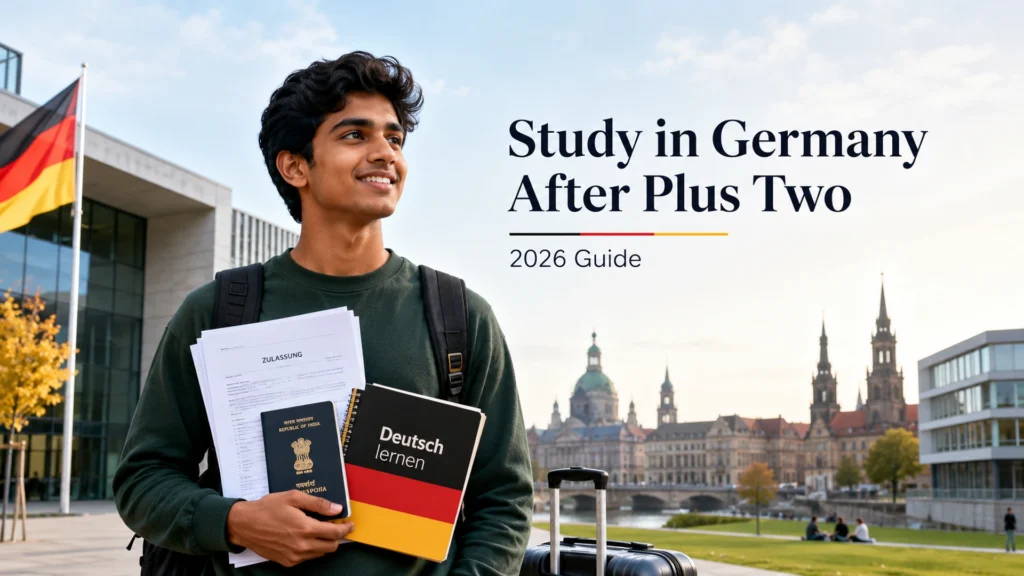
Can Kerala students study in Germany after Plus Two? Understand the 2026 eligibility rules, Studienkolleg, APS, German language, costs and visa process.
Study in Germany After Plus Two: 2026 Guide for Kerala Students
Understand the updated Class XII eligibility rule, Studienkolleg and Bachelor-year pathways, APS process, language requirements, study costs and visa preparation before planning a German degree.
For many students in Kerala, Germany stands out because its public universities offer respected degrees, strong links with industry and comparatively affordable study options. The difficult part is not deciding whether Germany is attractive. It is understanding exactly how an Indian Plus Two qualification is assessed.
The route is manageable once you separate three questions: Are you academically eligible? Which language does your chosen programme require? And have you allowed enough time for APS, admission and the student visa?
This 2026 guide explains the process in plain language for students searching for a Bachelor’s degree in Germany after Plus Two. Requirements can vary by university, so use this article for planning and confirm the final conditions on the official programme page before applying.
Can Indian Students Join a German University Directly After Plus Two?
Most Indian Class XII students need an additional academic step before starting a German Bachelor’s degree. Germany checks whether a school-leaving qualification is equivalent to its higher-education entrance qualification, known as the Hochschulzugangsberechtigung.
A Kerala State Board, CBSE, ISC or another recognised Indian Class XII certificate is therefore not usually treated as automatic direct entry. The applicant may need to complete Studienkolleg and pass the Feststellungsprüfung, or successfully complete one academic year of a relevant Bachelor’s programme in India.
There are exceptions. According to DAAD India’s Bachelor studies guidance, a valid JEE Advanced result may support subject-specific direct admission in technology and natural-science fields. Eligible IB, GCE and similar international qualifications may also lead to direct or subject-restricted admission, depending on the subject combination.
The university remains the final decision-maker. Even when you meet a general eligibility route, you must still satisfy the programme’s subjects, grades, language level, application deadline and any additional selection requirements.
What Changed for Indian Applicants in 2026?
The most important update is the new minimum Class XII score for the principal undergraduate pathways used by Indian applicants.
The rule applies from Winter Semester 2026/27
APS India states that applicants using the Studienkolleg pathway, or the pathway based on one successful Bachelor’s year in India, generally need at least 70% of the maximum obtainable overall marks in the Class XII certificate.
The threshold applies regardless of the examining board. It is an eligibility condition, not a promise of admission. Universities can set additional or more competitive requirements.
Read the official APS India eligibility update before submitting an application.
This change means that students planning to study in Germany after 12th should check their overall percentage before paying for applications or making financial commitments. Students below the threshold should obtain profile-specific advice rather than assuming that a private university, English-taught course or foundation provider can bypass the recognised entrance-qualification rules.
What Are the Admission Routes After Class XII?
There is no single route for every student. Your pathway depends on your school certificate, academic score, intended subject and any additional qualification you hold.
Route 1: Studienkolleg in Germany
Students with the required Class XII profile may qualify for subject-restricted admission through a preparatory college. After completing the course, they take the Feststellungsprüfung and then apply separately to a suitable university programme.
- Usually up to two semesters
- Mostly taught in German
- Subject stream must match the intended degree
- Entrance examination is commonly required
Route 2: One Successful Academic Year in India
A student may begin a regular Bachelor’s programme at a recognised higher-education institution in India and successfully complete one academic year before applying to Germany.
- Class XII threshold still applies
- The Indian academic year must be successfully completed
- German admission is normally subject-specific
- The intended German degree should match or closely relate to the Indian field
Route 3: Valid JEE Advanced Result
Students with a qualifying JEE Advanced result may apply directly for relevant technology or natural-science programmes, subject to the university’s current criteria and language requirements.
A JEE Main result alone should not be assumed to provide the same route. Verify the exact qualification requested by the university and APS checklist.
Route 4: Eligible IB, GCE or Similar Qualification
An internationally recognised school-leaving qualification may provide general or subject-specific university entry when the required subjects and levels are present.
Recognition depends on the complete subject combination, not simply the name of the school board. Check the official university requirements and relevant German qualification database.
Review Class XII marks, subjects and the 2026 rule.
Work towards the level required for Studienkolleg or the degree.
Submit through the university or uni-assist as instructed.
Attend Studienkolleg and pass the Feststellungsprüfung.
Use the qualification to apply for an aligned Bachelor’s programme.
What Is Studienkolleg and Who Needs It?
Studienkolleg is a full-time preparatory course for international applicants whose school qualification does not provide direct access to a German Bachelor’s programme. It helps students develop the subject knowledge and academic German needed for university-level study.
The course usually takes up to two semesters. Applicants may first have to pass an entrance examination called the Aufnahmeprüfung. At the end, students take the Feststellungsprüfung, or FSP.
Passing the FSP makes you eligible to apply within the relevant subject area. It does not automatically reserve a university seat. You still need to submit a degree application and meet the institution’s selection conditions.
Common Studienkolleg streams
T-Course
Engineering, mathematics, computer science and natural-science degrees at universities.
M-Course
Medicine, biology, pharmacy and related health or life-science subjects.
W-Course
Business, economics and selected social-science programmes.
G-Course
Humanities, arts-related academic fields and German studies.
S-Course
Language-focused degrees and selected related academic fields.
Applied-science streams
TI, WW, GD and SW streams may be used for universities of applied sciences.
Before choosing a Studienkolleg, confirm that its FSP and subject stream are accepted for your intended university and degree. Public and private preparatory providers can have different fees, application procedures and recognition arrangements.
How Much Percentage Is Required to Study in Germany After Plus Two?
For the main pathways applying from Winter Semester 2026/27, Indian applicants generally need at least 70% overall in Class XII. This includes the route through Studienkolleg and the route based on one successful Bachelor’s year in India.
Seventy per cent is a starting eligibility threshold. A competitive course can still assess your relevant subject marks, language certificate, entrance examination, previous university performance or other programme-specific criteria.
| Applicant profile | Likely pathway | What to verify |
|---|---|---|
| Class XII with at least 70% | Subject-restricted admission through Studienkolleg | Relevant subjects, German level, entrance examination and provider recognition |
| Class XII with at least 70% plus one successful Bachelor’s year | Possible direct subject-restricted Bachelor’s admission | Recognition of the Indian institution and relationship between the two study fields |
| Valid JEE Advanced result | Possible direct subject-specific application | Eligible technology or natural-science subjects and university criteria |
| IB, GCE or another international qualification | Possible general or subject-specific direct entry | Required subjects, levels, combinations and grades |
| Below the published threshold | Do not assume the standard pathway applies | Obtain an official eligibility assessment before paying application or provider fees |
Do You Need German or IELTS to Study in Germany?
The required language depends on the language of instruction and the admission route. German is not automatically compulsory for every English-taught degree, but it is central to most Studienkolleg pathways and German-medium Bachelor’s programmes.
German-taught Bachelor’s programmes
These programmes usually require an advanced recognised German certificate. The university may accept TestDaF, DSH, Goethe-Zertifikat, telc Deutsch or another specified qualification.
The exact level and minimum component scores differ, so follow the degree page rather than relying on a general B2 or C1 rule.
Studienkolleg
Studienkolleg is normally taught in German. DAAD India advises that applicants may need approximately B2 proficiency and can be tested in both German and relevant academic subjects during the entrance examination.
Starting German early gives students more time to develop academic vocabulary rather than preparing only to pass a certificate.
English-taught Bachelor’s programmes
An English-medium course may require IELTS, TOEFL, Cambridge English or another accepted certificate. There is no single IELTS score for all German universities.
English-taught Bachelor’s options are fewer than German-taught options, and the entrance-qualification rules still apply.
Student visa language evidence
Where the admission letter does not confirm language eligibility, the German Missions in India can request an approved certificate in the language of instruction. The current checklist should be reviewed before the visa appointment.
A medium-of-instruction letter should not be assumed to replace an approved certificate.
Even when your degree is taught in English, German can make a major difference in finding accommodation, handling public services, communicating at part-time work and building a social life. For a Plus Two student starting from A1, a structured A1–B2 plan is more realistic than postponing the language until admission arrives.
What Is the APS Certificate for Germany?
APS stands for the Academic Evaluation Centre India. It verifies Indian academic documents and assesses them using the applicable German higher-education eligibility criteria.
The APS certificate is generally part of the German student-visa process for applicants with Indian qualifications. Depending on the pathway, students should use the Class XII, JEE, undergraduate or other relevant APS checklist.
APS does not:
- issue university admission;
- select a degree or Studienkolleg for the student;
- guarantee that a university will accept the profile;
- issue or guarantee a German visa.
The university decides admission, and the German authorities decide the visa. Start the document review early, but apply only through the process and checklist published on the official APS India website.
Documents students commonly prepare
- Valid passport
- Class X certificate and mark sheet
- Class XII certificate and mark sheet
- APS certificate
- German or English language certificate
- Studienkolleg or university admission letter
- Bachelor’s transcripts for the one-year route
- Curriculum vitae
- Motivation letter where requested
- Proof of finance and health insurance
The university, APS and visa document lists are separate. A document accepted for one step may not satisfy the other two, so follow each official checklist independently.
How Much Does It Cost to Study in Germany?
Germany can be comparatively affordable, but “free education” is an oversimplification. Students need to budget for semester contributions, living expenses, insurance, travel, initial housing costs and any tuition charged by the institution or federal state.
Tuition at public universities
Many public universities do not charge a general tuition fee for a standard first Bachelor’s degree. Students usually pay a semester contribution for administration and student services.
Exceptions exist. Non-EU students at many public institutions in Baden-Württemberg are generally charged €1,500 per semester, subject to exemptions. Private universities and selected programmes can charge substantially more.
Blocked account for the student visa
€11,904The German Missions in India currently list €11,904 for the first year, with withdrawals limited to €992 per month. Verify the amount again when you begin the visa process because financial thresholds can change.
Costs beyond the blocked account
- APS, application and document expenses
- Language classes and examination fees
- Visa fee and travel
- Rental deposit and initial accommodation
- Semester contribution
- Tuition where applicable
Why extra funds matter
Your first month can cost more than the monthly blocked-account withdrawal because you may need to pay a deposit, buy household essentials and arrange local transport or registration.
Build a buffer rather than planning to depend entirely on part-time income immediately after arrival.
Can International Students Work While Studying in Germany?
Eligible international students from outside the EU can generally work up to 140 full days or 280 half-days per year. Current rules also provide a 20-hours-per-week alternative in relevant circumstances. Different treatment may apply to mandatory internships and certain student-assistant roles.
Part-time work can provide experience and help with some expenses, but it should not be the foundation of your visa budget. Work availability, German ability, study schedules and local living costs vary considerably.
What happens after graduation?
After successfully completing a German degree, international graduates may apply for a residence permit for up to 18 months to look for qualified employment. During this job-search period, graduates may take up employment while seeking a suitable skilled role.
Read the latest rules on the German government portal Make it in Germany before making employment or post-study plans.
When Should a Plus Two Student Start Preparing?
A practical preparation period is 12 to 18 months. Starting early is especially important when the student needs to progress from beginner German to the level required for Studienkolleg or a German-taught degree.
12–18 months before intake: Build the foundation
- Choose a broad study area based on your Plus Two subjects.
- Check whether the Studienkolleg or Bachelor-year route fits your profile.
- Begin German at A1 and plan steady progression.
- Understand the 70% Class XII requirement.
9–12 months before intake: Research programmes
- Compare universities, universities of applied sciences and Studienkollegs.
- Check the programme language, subject prerequisites and fees.
- Confirm whether the application is direct or through uni-assist.
- Prepare passport and academic documents.
6–9 months before intake: Complete application evidence
- Follow the correct APS pathway and checklist.
- Take the required German or English examination.
- Submit Studienkolleg or university applications before their deadlines.
- Prepare a motivation letter and CV where requested.
3–6 months before travel: Prepare the visa and arrival
- Accept the admission offer and follow enrolment instructions.
- Arrange the blocked account and required insurance evidence.
- Prepare the national student-visa application.
- Begin accommodation and pre-departure planning.
Germany’s winter semester generally begins in October and the summer semester in April. Not every Bachelor’s programme has a summer intake, so students often find more options for the winter semester. Always work backwards from the actual deadline stated by the university.
How Should You Choose a University in Germany?
Do not begin with the question “Which German city is best?” Begin with “Which programme fits my academic eligibility and career direction?” A famous city cannot compensate for a course that does not accept your qualification.
Review these points for every shortlisted programme:
- Entrance qualification and subject eligibility
- Need for Studienkolleg or direct entry
- Language of instruction
- Accepted language certificate
- Application route and deadline
- Tuition and semester contribution
- Practical training or internship opportunities
- Living and accommodation costs
- Recognition of the chosen Studienkolleg FSP
- University-specific selection criteria
DAAD’s programme databases, the university website and uni-assist can support your research. The official programme page should remain your final reference for admission conditions.
Why Do Kerala Students Consider Germany After Plus Two?
Germany appeals to students who want a combination of academic quality, applied learning and a clear connection between education and employment. Universities and universities of applied sciences offer different learning environments, allowing students to choose between more research-focused and more practice-focused programmes.
Low or no general tuition at many public universities
Many public institutions keep tuition comparatively low, although semester contributions, state-level exceptions and programme-specific fees must be included in the budget.
Strong technical and applied-study options
Germany is well known for engineering, computer science, natural sciences and industry-linked education, while also offering business, design, social-science and humanities programmes.
Opportunity to learn a major European language
German adds value beyond admission. It helps students participate more fully in university life, internships, workplaces and local communities.
A post-study route to qualified employment
Graduates can use the post-study job-search period to look for qualified employment aligned with their education, subject to the current residence rules.
How Medcity Supports Students Planning to Study in Germany
A Germany plan works best when academic eligibility and language preparation are considered together. Students who wait for an admission decision before beginning German can lose valuable preparation time, particularly when Studienkolleg is part of the route.
Medcity International Academy provides CEFR-aligned German training from A1 to B2 through classroom and online options, subject to current batch availability. Training focuses on the four language skills, practical communication and preparation for recognised examinations such as Goethe and telc.
Support can include:
- German A1, A2, B1 and B2 training;
- speaking, listening, reading and writing practice;
- Goethe and telc-oriented examination preparation;
- online and classroom learning options;
- initial guidance on Studienkolleg and Bachelor-year pathways;
- IELTS preparation where an English-taught programme requires it;
- study-abroad application and documentation guidance through the relevant support team.
Universities, APS and German visa authorities make the final eligibility, admission and visa decisions. Guidance should therefore be matched to the student’s actual marks, subjects and intended programme rather than presented as a guaranteed route.
Official Sources Reviewed
Admission, visa and financial rules can change. This guide was prepared using the following official or government-supported resources and should be reviewed against their latest versions before application:
- APS India — 2026 undergraduate eligibility update
- DAAD India — Bachelor studies and Studienkolleg guidance
- German Missions in India — Student visa checklist
- German Missions in India — Study and blocked-account guidance
- Make it in Germany — Student work and post-study residence rules
- Baden-Württemberg Ministry — Tuition fees for international students
Frequently Asked Questions About Studying in Germany After Plus Two
Can I study in Germany immediately after Plus Two?
Yes, you can begin the Germany admission pathway after Plus Two, but most Indian Class XII students cannot start a German Bachelor’s degree immediately. They generally need Studienkolleg and the Feststellungsprüfung, or one successful academic year in a recognised Bachelor’s programme in India. A valid JEE Advanced result or eligible international qualification may provide another route.
How much percentage is required in Class XII for Germany in 2026?
For admissions beginning with Winter Semester 2026/27, Indian applicants using the main Studienkolleg or one-year Bachelor’s pathways generally need at least 70% overall in Class XII. This is an eligibility threshold, not a guarantee of admission, and universities may apply additional programme-specific criteria.
Can I study in Germany after Plus Two without Studienkolleg?
It may be possible after successfully completing one academic year of a relevant Bachelor’s programme at a recognised institution in India. Students with a valid JEE Advanced result or an eligible IB, GCE or similar international qualification may also have a direct subject-specific route, depending on the university.
Is German compulsory for a Bachelor’s degree in Germany?
German is required for most German-taught Bachelor’s programmes and most Studienkollegs. It may not be an academic admission requirement for a fully English-taught degree, but English-medium Bachelor’s options are fewer and the student must still satisfy the German university entrance-qualification rules.
What German level is needed for Studienkolleg?
The exact requirement depends on the Studienkolleg, but applicants commonly need German around B1 or B2 and may have to pass an entrance examination. DAAD India advises approximately B2 for many Studienkolleg applications. Always follow the level and accepted certificate stated by the provider.
Is IELTS compulsory to study in Germany after Plus Two?
No. IELTS is mainly required when an English-taught programme asks for it or when approved English-language evidence is needed for the visa. Universities may also accept TOEFL, Cambridge English or another qualification. There is no single IELTS score that applies to every German Bachelor’s programme.
What is the blocked-account amount for Germany in 2026?
The German Missions in India currently list €11,904 for the first year, with a monthly withdrawal limit of €992. The required amount can change, so applicants should confirm the current figure on the official visa website before opening or funding the blocked account.
Are German public universities completely free?
Many public universities charge no general tuition for a standard first Bachelor’s degree, but students usually pay a semester contribution. Exceptions exist: many non-EU students in Baden-Württemberg pay €1,500 per semester, and private universities or selected programmes can charge separate tuition fees.
Can international students work part-time in Germany?
Eligible non-EU international students can generally work up to 140 full days or 280 half-days per year, with a 20-hours-per-week alternative under the current rules. Students should check how internships and student-assistant roles are counted and follow the conditions on their residence permit.
How early should I start preparing to study in Germany after Plus Two?
Starting 12 to 18 months before the intended intake is practical. This gives you time to check eligibility, learn German, prepare APS documents, research universities, complete language tests, submit applications and arrange the blocked account, insurance and student visa.
Does Medcity provide German coaching for students planning a German degree?
Yes. Medcity International Academy provides German training from A1 to B2 through classroom and online options, subject to batch availability. Training includes speaking, listening, reading and writing practice, along with preparation support for recognised examinations such as Goethe and telc.
Start Your Germany Preparation with a Clear Pathway
Your first step is not choosing a city or paying an application fee. It is checking whether your Class XII marks, subjects and planned degree fit a recognised route—and then beginning the required language preparation early enough.
Speak with Medcity about German A1–B2 learning options and the preparation timeline for your study goal. Admission and visa outcomes remain subject to the decisions of the university, APS and German authorities.